
The Direct-to-Consumer Reality: Surviving the Great Fragmentation

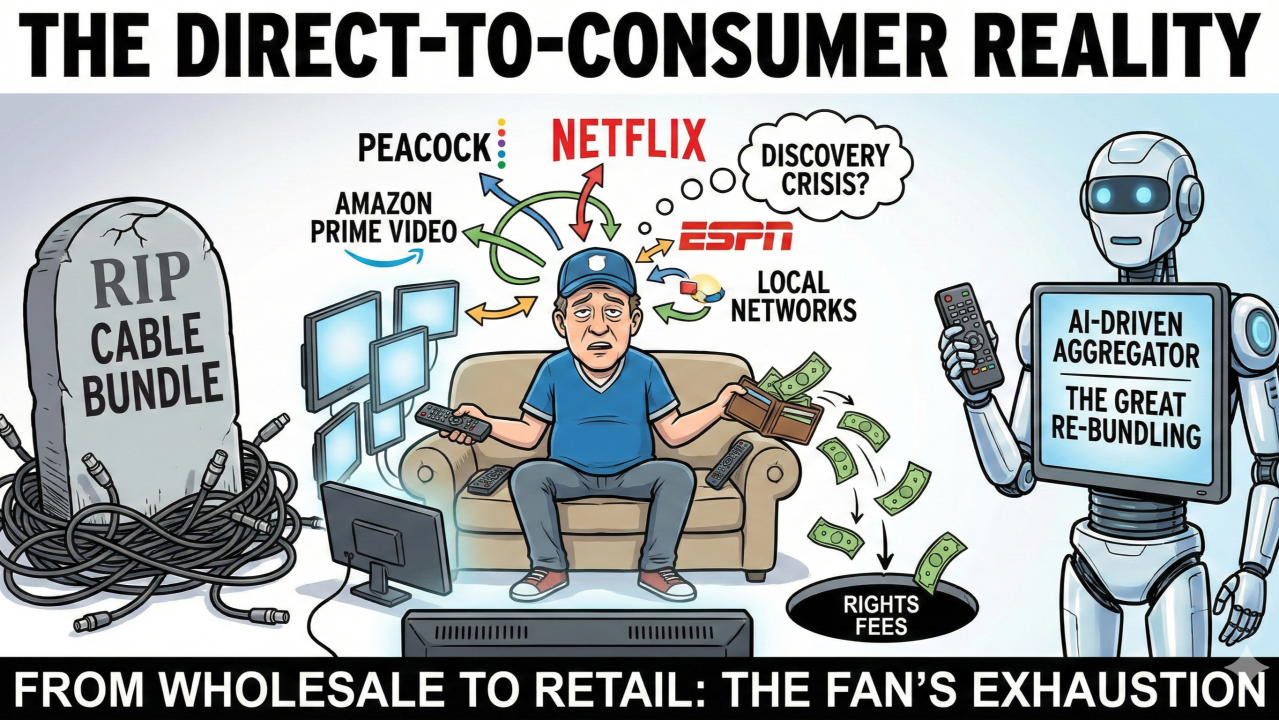
Subtitle: The cable bundle is officially dead. In 2026, the sports fan is not asking “What channel is the game on?” but “Which subscription do I need to activate today?”
Introduction
Remember the golden era of the cable bundle? You paid one (admittedly high) bill, turned to ESPN or your local Regional Sports Network (RSN), and the game was just there.
Welcome to 2026. The “Streaming Wars” did not result in a single winner; they resulted in shattered glass.
The transition to Direct-to-Consumer (DTC) streaming was promised as a utopia of choice and lower costs. Instead, it has created a landscape defined by severe “fragmentation fatigue.” As sports leagues maximise their revenue by slicing up their media rights and selling them to the highest tech bidders, the ultimate cost, both financial and experiential, has been passed directly to the fan.
If the previous articles in this series covered the optimisation of capital, infrastructure, and operations, this article tackles the final, and most volatile, variable in the sports business equation: The Fan’s wallet.
The Insight: From Wholesale to Retail
The foundational business model of sports media has flipped.
For decades, leagues operated on a B2B “wholesale” model. They sold rights to cable networks, and those networks relied on millions of non-sports fans to quietly subsidise the cost of the sports channels within the broader cable bundle.
Today, we are in a B2C “retail” model. The subsidy is gone.
Sports organisations and streaming platforms are now extracting the true market value directly from the hardcore fan. The result? The average dedicated sports fan in 2026 is spending significantly more across a web of DTC apps ($110+ per month) than they ever did on a traditional cable package, just to access the same amount of live inventory.
Furthermore, the biggest casualty of this shift is not just money; it is discovery. The frictionless viewing experience has been replaced by a chaotic scavenger hunt. Toggling between platforms, dealing with stream latency, and simply figuring out where the game is broadcasting have become major sources of friction.
The Evidence: The 2026 Broadcasting Maze
To understand the sheer complexity of the modern sports calendar, we just have to look at how a fan consumes the two biggest leagues in the United States in 2026.
Case Study: The NFL and NBA Rights Matrix
- The NFL’s Sliced Pie: The NFL is a masterclass in maximising rights fees through fragmentation. To watch a full season of your favourite team in 2026, a fan needs access to local broadcast antennas (CBS/FOX), ESPN (Monday Night Football), Amazon Prime (Thursday Night Football), Peacock (exclusive streaming games), Netflix (which secured the massive Christmas Day games), and YouTube TV (for out-of-market Sunday Ticket).
- The NBA’s New Era: The NBA’s massive 11-year rights deal, which kicked in for the 2025/2026 season, completely reshaped basketball viewership. By moving away from exclusive TNT dominance, the league scattered its inventory across Disney (ESPN/ABC), Comcast (NBC/Peacock), and Amazon Prime Video.
- The Result: A fan of the Los Angeles Lakers or the Kansas City Chiefs cannot simply “buy the team’s channel.” They are forced to manage a portfolio of 4 to 5 distinct subscriptions, navigating different user interfaces, paywalls, and streaming delays, just to follow a single narrative thread over a season.
The Next Phase: The Re-Bundling
The current state of fragmentation is financially and experientially unsustainable for the consumer. We are hitting the absolute limit of fan wallet share and patience.
In 2026, the competitive advantage for media companies is no longer just acquiring the rights to the game; it is solving the discovery crisis. We are seeing the early stages of The Great Re-Bundling.
Tech giants and media conglomerates are racing to become the “sports-first aggregator”, a unified, AI-driven dashboard that tracks your favourite teams, consolidates your subscriptions, and routes you directly to the correct stream without forcing you to hunt through individual apps.
Conclusion
The direct-to-consumer reality has proven one thing definitively: live sports remain the most valuable media property on earth. It is the only content capable of driving millions of new app downloads and subscriptions in a single weekend.
However, leagues must be careful not to optimise their broadcast revenue at the expense of their future audience. If you make the product too hard to find and too expensive to assemble, you risk alienating the next generation of casual fans, whose attention is already being drawn to gaming and creator-driven social media.
The winners of the next decade will not be the platforms with the most fragmented exclusive rights; they will be the platforms that figure out how to seamlessly put the pieces back together for the fan.