
The New Geographies: From Hosting Events to Owning Ecosystems

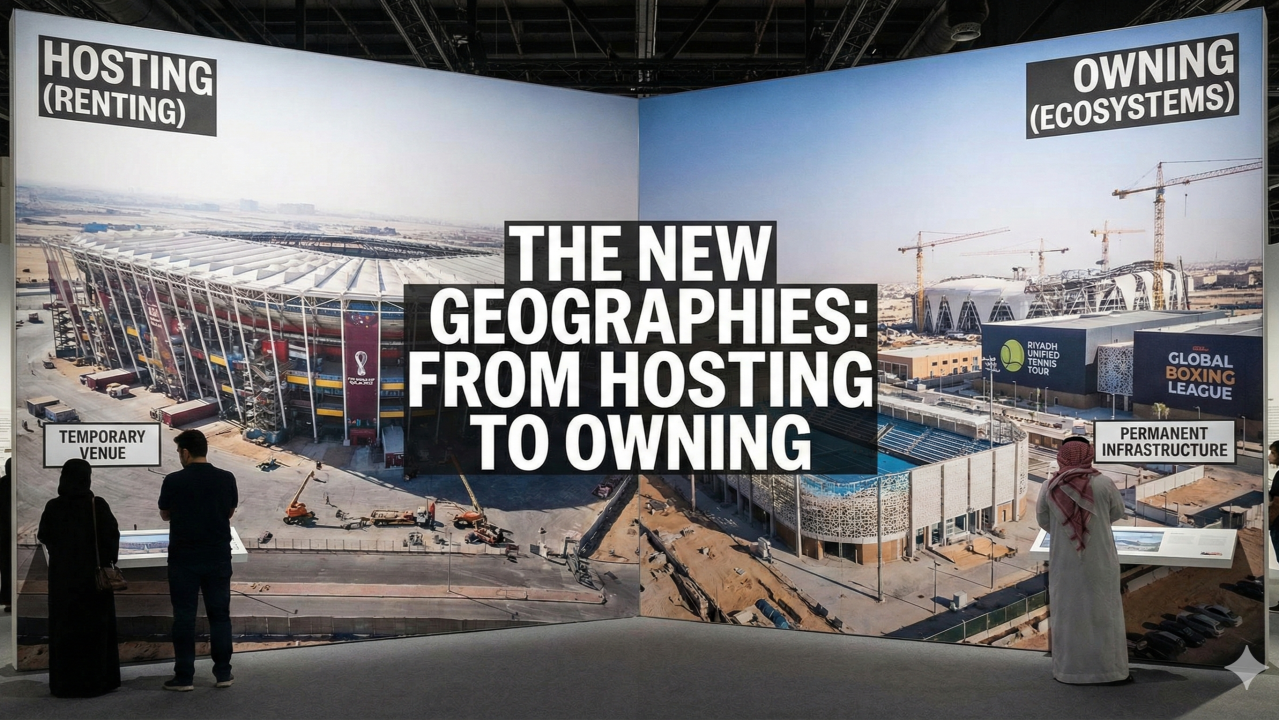
Subtitle: The map of global sport has been redrawn. The Middle East’s strategy has evolved from “renting” the world’s attention via mega-events to “owning” the intellectual property and infrastructure that underpins the entire industry.
Introduction
For the first two decades of the 21st century, the relationship between the Middle East and global sport was transactional. It was defined by “hosting.”
Qatar hosted the World Cup. Abu Dhabi and Bahrain hosted F1 races. Saudi Arabia hosted heavyweight boxing. The strategy was clear: pay a premium fee to rent the world’s attention for a weekend or a month, driving tourism and brand awareness.
Welcome to 2026. The “renting” phase is over.
The centre of gravity in the sports world has shifted permanently East. We are no longer talking about “emerging markets”; we are talking about the new primary capital of the sports ecosystem. The strategy has pivoted from Soft Power (Hosting) to Hard Assets (Owning).
This is not about “sportswashing” anymore, a lazy term that fails to capture the sophistication of the investment thesis. It is about economic diversification and geopolitical leverage through the acquisition of long-term, cash-generative intellectual property.
The Shift: Owning the Calendar
The fundamental shift defining 2026 is the move from buying events to buying structures.
When you host an F1 race, you are a tenant. You pay the landlord (Liberty Media) for the privilege. When you buy the league or the commercial rights to a sport, you become the landlord.
This is the “Sovereign Ecosystem” strategy. Sovereign Wealth Funds are no longer content with being sponsors; they are becoming the primary liquidity providers and operational architects of entire sports. They are consolidating fragmented industries (like golf, tennis, and boxing) and rebuilding them with Riyadh, Doha, or Abu Dhabi as the commercial headquarters.
Case Study: The “Unified” Tennis Tour
The clearest evidence of this shift in 2026 is the transformation of professional tennis.
For decades, tennis was a fractured mess of competing governance bodies (ATP, WTA, ITF, Grand Slams). It was a sleeping giant, under-monetised and confusing for fans.
Enter the “Riyadh Accord” (The Unified Tour).
Following the blueprint established by golf in the early 2020s, Middle Eastern capital didn’t just sponsor a tournament; they funded the restructuring of the entire sport.
- The 10th Masters: They did not just add a tour stop; they created a new pillar event in January, effectively reshaping the season’s geography before the Australian Open.
- Commercial Unification: By injecting billions into a unified commercial entity, they forced the merger of the men’s and women’s commercial rights, streamlining the product for broadcasters and sponsors.
- The Result: The sport is now governed, commercially, from a boardroom that answers to Sovereign capital. They did not just buy a week of tennis; they bought equity in the sport’s future.
This move proved that the region is no longer a passive host. It is an active operator, capable of solving structural problems that Western legacy organisations could not solve for 50 years.
The New Hub: Qiddiya City
While the “Unified Tour” represents owning the IP, Qiddiya City represents owning the physical reality.
By 2026, Qiddiya is no longer a rendering; it is operational. It is the world’s first city built explicitly for “Play.”
- The Difference: Unlike an Olympic park that becomes a ghost town after the closing ceremony, Qiddiya is designed as a permanent industrial hub for gaming, esports, and performance athletics.
- The Strategy: It creates a “stickiness” that hosting major events lacks. Teams do not just visit for a match; they set up training bases there. Esports leagues do not just hold a final there; they headquarter their operations there.
Conclusion
The map has changed.
For a century, the axis of sports power ran from New York to London to Lausanne. Today, that axis runs through Riyadh, Doha, and Abu Dhabi.
Western entities must stop viewing this region as merely a source of “dumb money” or a temporary ATM. In 2026, they are the partners, the landlords, and the innovators. The question for global leaders is no longer “Should we go there?” It is “How do we integrate into the new centre of gravity?”
The geography of sport has not just expanded; it has relocated.