
The 2026 State of the Industry: The Operator’s Playbook

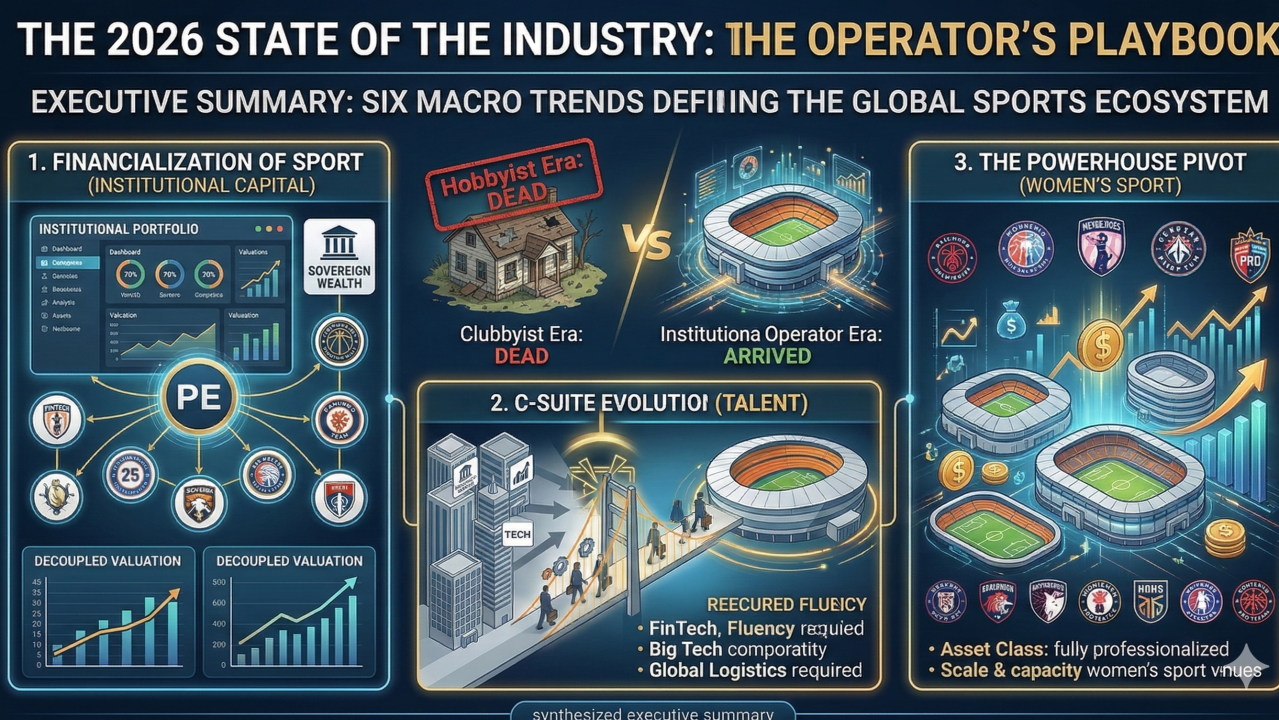
Subtitle: Over the last 11 weeks, we have deconstructed the forces reshaping the business of sport. Here is the synthesised executive summary of the six macro trends defining the global ecosystem in 2026.
Introduction
If there is one overarching thesis to the 2026 sports business landscape, it is this: The era of the “hobbyist” is dead; the era of the “institutional operator” has arrived.
We have moved past the romanticised version of sports ownership where wealthy individuals bought teams as vanity assets and ran them like family businesses. Today, sports franchises are highly financialised, technologically complex, multi-national entertainment conglomerates.
To thrive in this environment requires a completely new playbook. Here is the executive summary of the six foundational shifts that every leader, investor, and operator must navigate in 2026.
1. The Financialisation of Sport (Institutional Capital)
The influx of Private Equity and Sovereign Wealth is no longer a trend; it is the baseline.
- The Shift: Valuations have decoupled from standard revenue multiples. Teams are now valued as scarce, non-correlated anchor assets within larger real estate and media portfolios.
- The Playbook: Success requires moving beyond single-team ownership to multi-club and multi-sport models, maximising centralised efficiencies and building global talent pipelines.
2. The C-Suite Evolution (Talent)
You cannot run a 2026 sports conglomerate with a 2015 front office.
- The Shift: The most critical hires are no longer traditional marketers or ticket-sales veterans. The modern C-Suite requires executives fluent in Mergers & Acquisitions (M&A), data governance, and algorithmic yield management.
- The Playbook: Organisations must recruit “outside the walls” of sports, pulling talent from fintech, big tech, and global logistics to manage the complexity of the modern franchise.
3. The Powerhouse Pivot (Women’s Sport)
Calling women’s sport an “emerging trend” is now intellectual laziness. It is a fully established, high-margin asset class.
- The Shift: The “Great Unbundling” of media and sponsorship rights has revealed the true, massive standalone value of women’s properties.
- The Playbook: The bottleneck is no longer demand; it is supply. Capital must be deployed aggressively to address the Capacity Crisis through purpose-built infrastructure (like the KC Current’s stadium model) to stop leaving millions in match-day revenue on the table.
4. The Invisible Hand (AI Operations)
The hype cycle of generative AI fan art is over. True value lies in boring, backend efficiency.
- The Shift: AI has moved to the COO’s office. It is now utility infrastructure.
- The Playbook: Implement predictive logistics to fix stadiums before they break, utilise algorithmic yield management to price every square foot of an arena in real-time, and engineer “frictionless” venues (like the Intuit Dome) that eliminate queues and drastically increase per-cap spending.
5. The New Geographies (Middle East)
The centre of gravity has permanently shifted East, moving from a transactional relationship to an ownership model.
- The Shift: Sovereign Wealth Funds have abandoned the “Soft Power” strategy of merely hosting events. They are aggressively pursuing “Hard Assets” by buying the intellectual property, commercial rights, and infrastructure of global sports.
- The Playbook: Western entities must stop viewing the region as a temporary ATM and start integrating with hubs like Qiddiya City, which are built as permanent, operational headquarters for the future of gaming and athletics.
6. The Direct-to-Consumer Reality (Media)
The cable bundle is dead, and the streaming wars broke the user experience.
- The Shift: Moving from a B2B “wholesale” model to a B2C “retail” model has maximised rights fees for leagues but passed immense financial and logistical friction onto the fan, resulting in severe subscription fatigue.
- The Playbook: The competitive advantage is now solving the Discovery Crisis. The next wave of massive value creation won’t come from further fragmenting rights, but from the “Great Re-Bundling” AI-driven aggregation platforms that seamlessly reconnect the fan with the game.
Conclusion
The sports industry in 2026 is richer, smarter, and infinitely more complex than it was a decade ago.
Capital alone is no longer a differentiator; operational excellence is. The organisations that will dominate the next decade are the ones that can seamlessly integrate institutional finance, backend AI, purpose-built infrastructure, and frictionless fan experiences into a single, cohesive machine.
The game has not just changed. It is an entirely new sport.