
Phase 0 – Decision-Grade Diagnostic

Context
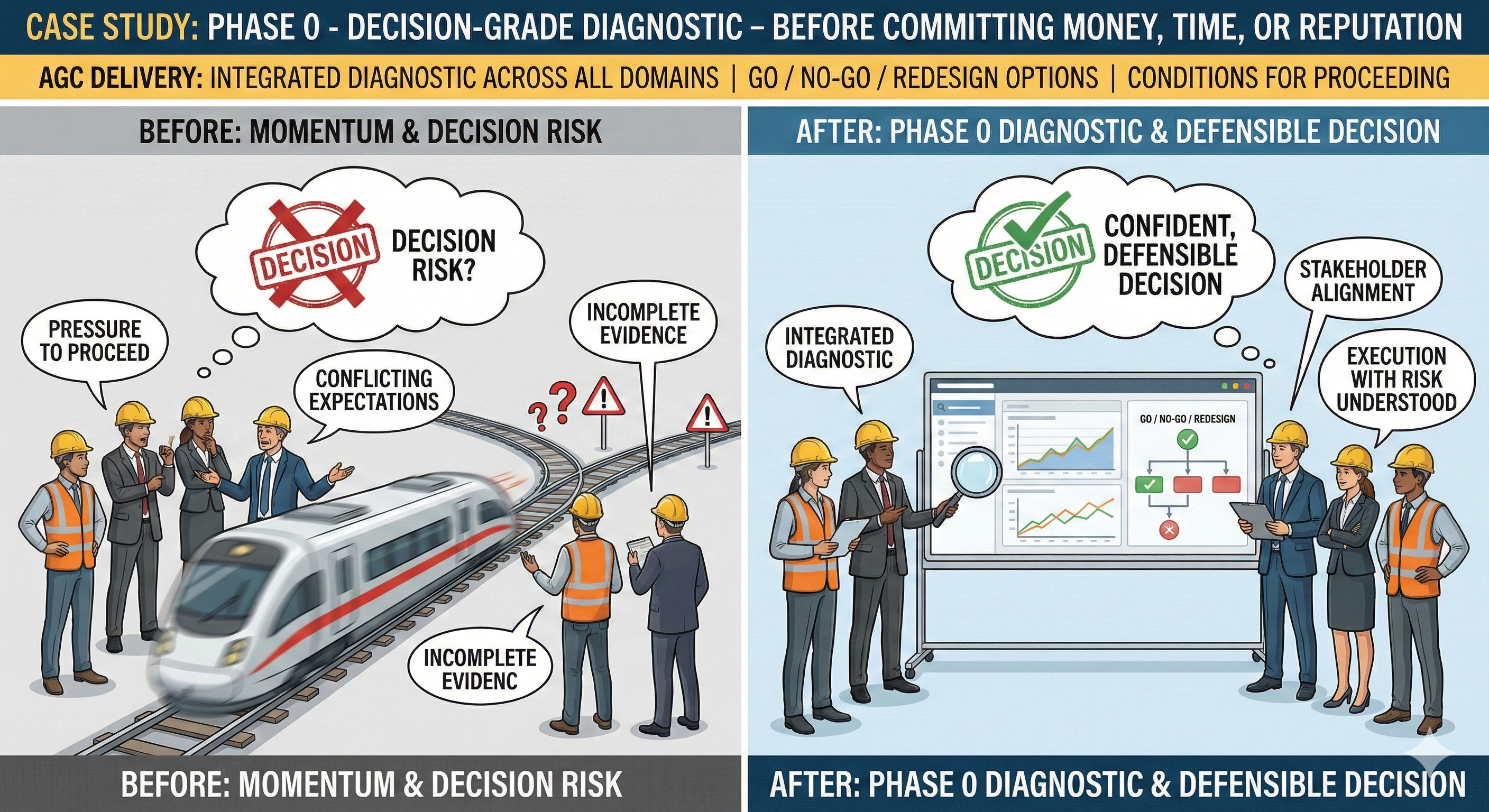
A multi-stakeholder sports project was approaching an irreversible commitment that would involve
significant capital, public visibility, and long-term reputational exposure. While multiple diagnostics had
already been completed, the decision-makers faced pressure to proceed under compressed timelines
and heightened scrutiny.
AGC was engaged to apply Phase 0 as the final decision gate before commitment.
Symptoms
• Imminent capital deployment with limited ability to reverse course
• Increased scrutiny from government, investors, and media
• Residual uncertainty across assumptions, risk ownership, and sequencing
• Decision-makers seeking assurance, not further analysis
• High personal exposure for board members and executives
Despite prior work, confidence had not yet been converted into defensibility.
Diagnosis
AGC conducted a Phase 0 – Decision-Grade Diagnostic to test whether the organisation was genuinely ready to commit.
Phase 0 examined:
• whether prior diagnostics were complete, coherent, and aligned
• unresolved assumptions and residual risk
• clarity of decision ownership and accountability
• governance readiness for public and investor scrutiny
• downside scenarios and reversibility
The diagnostic revealed that while the direction was broadly sound, several critical assumptions remained
implicit and certain risk ownership had not been formally assigned.
Prescription
AGC recommended conditional proceed, subject to explicit resolution of identified gaps.
Rather than delaying indefinitely or proceeding on confidence alone, AGC set out a short, targeted set of
actions required to convert readiness into decision-grade defensibility.
This included:
• formalising risk ownership at board level
• documenting decision logic and evidence trails
• clarifying escalation thresholds
• aligning governance records with external scrutiny expectations
Only once these actions were completed did AGC recommend proceeding.
Delivery (Where Warranted)
Following Phase 0 clearance, AGC supported controlled mobilisation into delivery, governed by the
conditions established during the diagnostic.
No delivery activity was initiated prior to Phase 0 completion.
Outcome
• Capital was committed with documented, defensible rationale
• Board and executives proceeded with materially reduced personal exposure
• External stakeholders gained confidence in the decision process
• Residual risks were explicit, owned, and managed
• The organisation avoided proceeding under false certainty
Most importantly, the decision to proceed was owned, not deferred.
Why This Matters
High-stakes failures rarely result from a lack of effort.
They result from committing before readiness is fully tested.
Phase 0 exists to protect decision-makers at the moment it matters most.
Governing Diagnostic
Phase 0 – Decision-Grade Diagnostic
When to Use This Diagnostic
• Before irreversible capital commitment
• When public, political, or investor scrutiny is high
• After multiple diagnostics but before final approval
• When personal liability or reputational exposure exists