
From Facilities to Flywheels: Rethinking Sports Infrastructure

Introduction: Beyond the Inaugural Fanfare
Imagine the scene: a ribbon-cutting ceremony for a gleaming new stadium. The architecture is stunning, the pitch is perfect, and on opening day, 50,000 cheering fans create an unforgettable spectacle. The project is hailed as a triumph of civic pride and sporting ambition. But fast forward six months. The roar of the crowd has been replaced by silence. For over 300 days a year, this multi-million dollar asset sits empty, mainly a dormant monument to a few dozen event days. The initial pride gives way to a daunting financial reality: the staggering, relentless cost of maintaining a sleeping giant.
This is the unspoken challenge haunting sports infrastructure globally. We have become experts at building impressive facilities, but we have failed to create sustainable ecosystems. We invest billions in hardware, concrete, steel, and turf, while neglecting the operating system that can turn these cost centres into self-propelling flywheels of community, content, and commerce.
This article explores a fundamental shift in thinking: from viewing infrastructure as a static container for events to reimagining it as a dynamic, integrated platform that generates its own momentum, a true flywheel that powers the club, the community, and the city around it.
The Problem: The “Field of Dreams” Fallacy
For decades, the prevailing philosophy in sports infrastructure has been a simple one: “If you build it, they will come.” This “Field of Dreams” approach treats a stadium or arena as a finished product, a piece of hardware whose primary function is to host games. This model is fundamentally flawed, creating a legacy of “white elephants” that are beautiful on game day but a burden every other day of the year.
The weaknesses of this traditional model are stark:
- Crippling Financial Drain: The Capital Expenditure (CAPEX) to build a modern venue is astronomical. However, the Operational Expenditure (OPEX), including security, utilities, maintenance, and staffing, is a relentless drain on resources, often far exceeding the revenue generated from a limited number of events.
- Chronic Underutilisation: A typical stadium is used for its primary purpose less than 5% of the year. This represents a colossal waste of prime real estate and embedded resources, a luxury few cities or clubs can afford.
- Limited Community Integration: The traditional stadium is an island. It is a destination people travel to for an event and immediately leave from. It rarely functions as an organic, integrated part of the neighbourhood’s daily life, contributing little to the local social fabric outside of match days.
- Static and Inflexible Design: Venues are often purpose-built for a single sport, resulting in a design that is static and inflexible. This design rigidity makes it incredibly difficult and expensive to adapt the space for other uses, locking the owners into a single, often seasonal, revenue stream.
The result is a portfolio of magnificent but inefficient assets that fail to deliver on their full potential, both financially and socially.
The Solution: Infrastructure as a Flywheel
The flywheel, a concept popularised in the business world by Jim Collins, is a self-reinforcing loop where each component pushes the next, creating compounding momentum. When applied to sports infrastructure, it transforms a static facility into a vibrant, multi-faceted ecosystem.
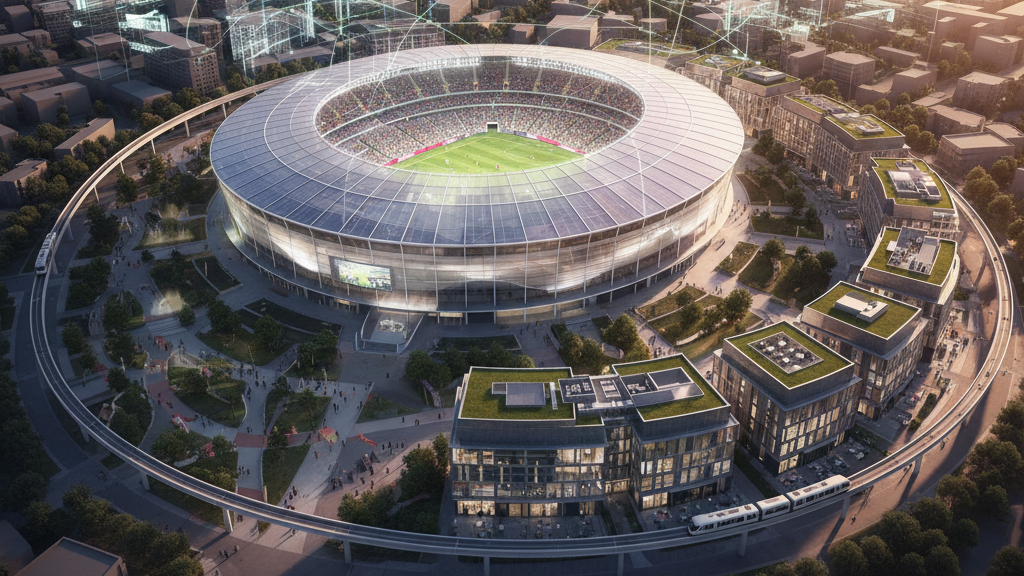
The venue is no longer just a place to watch a game; it becomes the central hub of a powerful flywheel.
- Component 1: The Anchor (Sporting Events): Elite sport remains the core, the primary driver that builds the brand and attracts the initial mass audience.
- Component 2: The Hub (Community & Lifestyle): The space around the anchor is activated year-round with restaurants, cafés, parks, fitness centres, medical clinics, and public spaces that draw in the local community daily.
- Component 3: The Engine (Commercial & Content): This daily traffic is monetised through retail, co-working spaces, and corporate events. The venue itself becomes a media hub, generating a constant stream of digital content that engages fans globally.
Each part feeds the next: The anchor event brings people to the hub. The daily life of the hub creates new commercial opportunities. The revenue from the commercial engine is reinvested in the anchor team, improving performance and restarting the cycle with even greater force.
The benefits of this integrated model are profound:
- Sustainable, Diversified Revenue Streams: Revenue is no longer dependent on ticket sales. It flows from retail leases, corporate partnerships, daily food and beverage sales, and media rights.
- Year-Round Community Engagement: The venue becomes a beloved and essential part of the city, a place to work, eat, socialise, and live, not just on match day, but every day.
- Data-Rich Environments: By integrating digital layers (like a venue app and public Wi-Fi), owners can understand user behaviour, personalise experiences, and create targeted commercial opportunities.
- Enhanced Brand Loyalty: A club or team becomes deeply woven into the daily lives of its supporters, fostering a more profound and resilient connection than one based solely on ninety minutes of play.
Real-World Applications: The Flywheel in Action
This is not a theoretical fantasy. Visionary organisations are already building powerful flywheels.
Consider Tottenham Hotspur Stadium in London. It was designed not just to host football matches, but to be a 365-day-a-year destination. It features an on-site brewery, premium restaurants, the world’s first stadium-based cheese room, and has a long-term deal to host NFL games. It hosts concerts, boxing matches, and corporate events. The stadium is not just a home for the club; it’s an entertainment and leisure hub that has catalysed the regeneration of the entire local area.
On a different scale, look at the evolution of the community sports hub. A traditional tennis club with 12 courts might struggle financially. But a modern hub builds a flywheel: it adds four padel courts to attract a new demographic, a physiotherapy clinic to serve athletes, a high-quality café that becomes a local meeting spot, and flexible event space. The café patrons try padel; the padel players use the physio; the entire community uses the space. This is a micro-flywheel in action.
The Flywheel Playbook: A Framework for Activation
Transitioning from a facility to a flywheel requires a strategic, multi-layered approach:
- Design for Flexibility, Not Just Function: The architectural brief must prioritise multi-use, adaptable spaces from day one. This means designing locker rooms that can also serve as green rooms, concourses that can host markets, and ensuring the digital and physical infrastructure can support a diverse range of events.
- Anchor with Excellence, Activate with Variety: While the primary sports team is the heart of the flywheel, the business plan must be built around a rich calendar of secondary and tertiary events, concerts, conferences, community festivals, and local sports leagues.
- Integrate Commerce and Community: Curation is key. The retail and dining options should not be generic afterthoughts; they should reflect the local culture and create a genuine destination. Public parks, art installations, and accessible spaces are not costs; they are investments in daily foot traffic.
- Build the Digital Layer: A seamless digital experience is non-negotiable. A unified venue app for ticketing, ordering food, and accessing content, combined with robust data analytics, is the central nervous system of the modern flywheel.
“A great facility hosts events for a few hours. A great flywheel builds a community and an economy that thrives 24/7.”
More Than Bricks and Mortar
For too long, we have measured the success of our sports infrastructure by its capacity, its architecture, or the trophies won within its walls. Those metrics are no longer enough. The future belongs to venues that are measured by their vitality, their integration into the urban fabric, and the momentum they create long after the final whistle has blown.
These are not just buildings; they are platforms for human connection and economic opportunity. As cities, clubs, and federations plan the next generation of infrastructure, the fundamental question must change. It is no longer, “What facility should we build?” but rather, “What powerful, lasting flywheel can we create?”