
The Invisible Hand: Moving AI from Marketing Buzzword to Operational Backbone

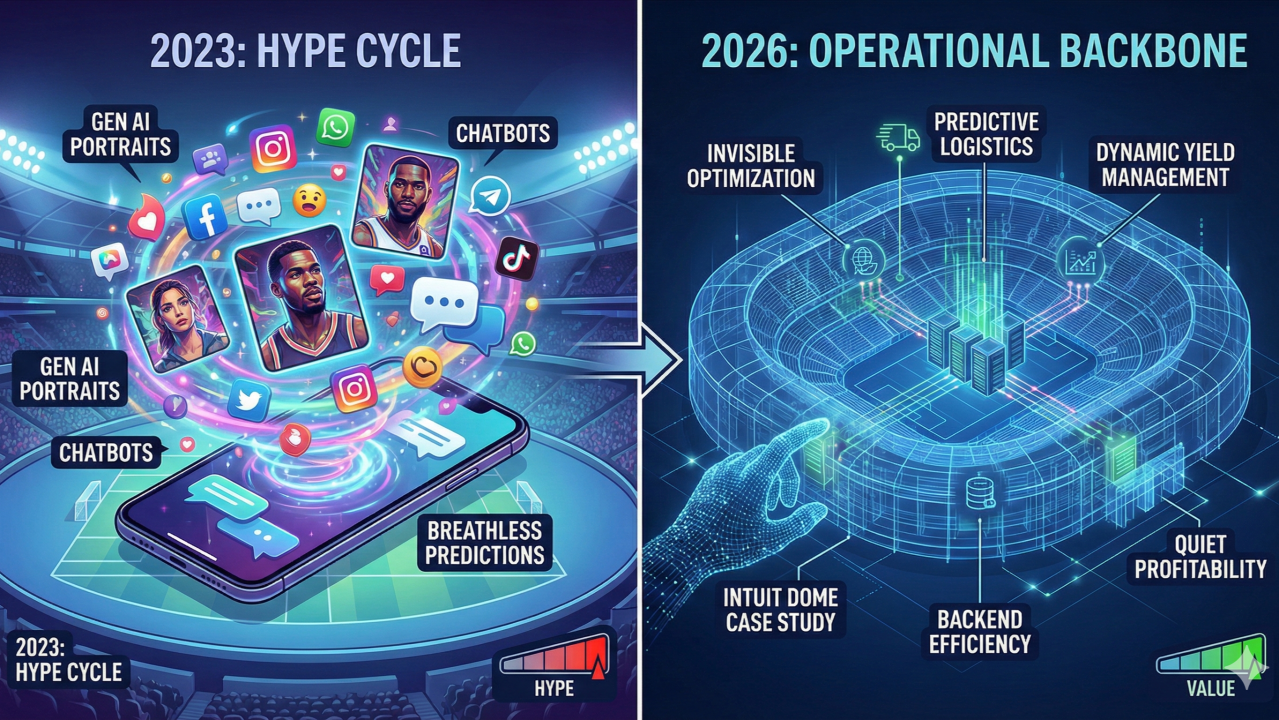
Subtitle: The hype cycle is over. In 2026, the true value of Artificial Intelligence in sports is not in flashy generative fan art; it is in the unsexy, crucial backend operations that save millions and optimise enormous, complex organisations.
Introduction
Remember 2023? That was the year Artificial Intelligence exploded into the sports world’s collective consciousness. It was a period defined by breathless LinkedIn posts, scary predictions of robot referees, and a lot of flashy, novelty applications, such as generative player portraits and basic chatbots.
It was the peak of the “hype cycle.”
Welcome to 2026. The hype has settled, and a quieter, more profound reality has taken hold.
AI in sports has graduated. It has moved from the marketing department to the COO’s office. Today, for the sophisticated global franchises we have been discussing in this series, AI is no longer a differentiator to boast about in a press release; it is essential utility infrastructure, as crucial as electricity or WiFi.
If the previous articles in this series highlighted the need for sophisticated “operator” talent in the C-suite, AI is the tool those operators are using to scale. It is the invisible hand now guiding the most complex machinery in the sports business.
The Shift: From Creation to Optimisation
The fundamental shift over the last three years is away from generative AI (creating new content) toward predictive and operational AI (optimising existing processes).
While generative AI is still fun for fan engagement, the return on investment there is notoriously difficult to measure. Operational AI, however, impacts the EBITDA immediately.
The most progressive organisations have realised that managing a multi-billion dollar sports and entertainment district with spreadsheets and gut instinct is professional malpractice. They are turning over the keys of their most complex, data-heavy operations to algorithms that don’t sleep, don’t have biases, and can process terabytes of information in milliseconds.
Case Study: The Intuit Dome & The Frictionless Economy
To see this operational revolution in practice, we look to the Intuit Dome, home of the LA Clippers.
When it opened in 2024, it was marketed as a basketball arena. By 2026, it will be recognised as a high-efficiency data centre that also hosts basketball games. It set the standard for the “Invisible Hand” of AI operations:
- The Death of the Queue: Using advanced computer vision (similar to Amazon Go technology), the arena eliminated traditional concession stands. Fans grab a beer and walk away. There is no cashier, no barcode scanning, and no line. The AI tracks the item and charges the account instantly.
- The Result: By removing the “transaction friction,” the Clippers did not just improve the fan experience; they radically altered the economics. Fans who do not wait in line spend significantly more money. In 2026, the Intuit Dome reports per-cap spending figures that dwarf those of traditional arenas, simply because AI removed the bottleneck of human transactions.
- Predictive staffing: The venue uses historical data and real-time ingress patterns to dynamically optimise staffing levels. If the AI detects a surge at the South Gate, it redeploys security assets instantly, ensuring safety while minimising wasted man-hours.
The Backend Reality: Beyond the Arena
The lessons from the Intuit Dome are now being applied across the industry in three critical, non-venue areas:
1. Dynamic Yield Management: For years, sports teams used basic “variable pricing.” Today’s leading franchises use yield management systems similar to those airlines use. AI models ingest thousands of data points in real-time secondary market velocity, local weather forecasts, opponent injury reports to adjust pricing minute-by-minute. It is not just about maximising ticket revenue; it is about optimising the total yield of every asset, from suite pricing to parking inventory.
2. Automated Logistics: Modern sports organisations are logistical nightmares. Operational AI now manages these workflows. Instead of fixing HVAC systems or escalators when they break, predictive maintenance models analyse sensor data to predict failures before they happen, saving seven figures in annual emergency repair costs.
3. Hyper-Personalisation at Scale: With tens of millions of global fans, human marketers cannot manually personalise experiences. AI is now the engine of the fan database. It does not just know you attended five games; it knows you buy two IPAs in the third quarter and prefer aisle seats. It automates the delivery of the right offer through the right channel at the right time to millions of individuals simultaneously.
Conclusion
The question for sports leaders in 2026 is no longer “What is your AI strategy?” The question is “How is AI optimising your operations strategy?”
If you are still using AI primarily to write press releases or generate social media images, you are missing the revolution. The true power of this technology lies in its ability to make the complex, expensive, and chaotic business of running a global sports property boringly efficient.