
Governance & Compliance Diagnostic Case Study

Context
A national sports organisation was preparing to enter a multi-year commercial and infrastructure
arrangement involving public funding, private sponsorship, and international sanctioning.
While leadership believed governance was “largely in place,” external stakeholders had raised concerns
about decision authority, compliance exposure, and personal liability for executives and board members.
AGC was engaged to determine whether the organisation was genuinely fit to proceed.
Symptoms
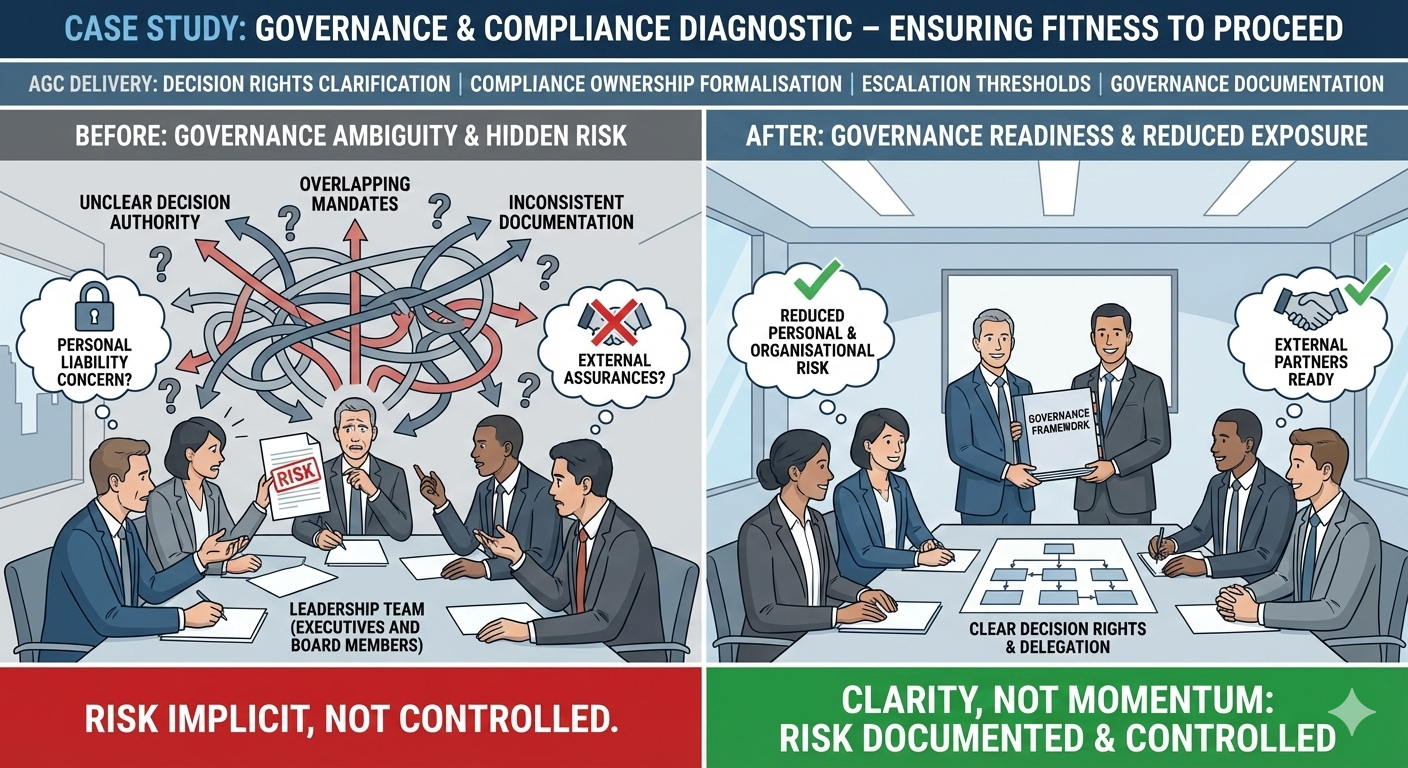
• Ambiguity around who held final decision authority
• Overlapping committee mandates and blurred accountability
• Inconsistent compliance documentation across functions
• Heightened concern from board members regarding personal exposure
• External partners requesting additional assurances before committing
Despite confidence internally, risk was implicit rather than controlled.
Diagnosis
AGC conducted a Governance & Compliance Diagnostic to test whether the organisation’s governance framework was capable of supporting the proposed commitments.
The diagnostic examined:
• decision rights and delegation structures
• board and executive accountability
• regulatory and contractual compliance exposure
• escalation and risk ownership mechanisms
• alignment between governance design and operational realityEvidence review and interviews revealed several latent governance gaps that would have created material exposure once contracts were executed.
Prescription
AGC recommended a pause before commitment.
Rather than proceeding on the existing structure, AGC set out a sequenced remediation plan, including:
• clarification and reallocation of decision rights
• formalisation of compliance ownership
• restructuring of key committees
• introduction of documented escalation thresholds
• governance documentation suitable for external scrutiny
Critically, AGC advised against progressing to delivery until these changes were formally adopted.
Delivery (Where Warranted)
Once governance remediation was completed and validated, AGC supported the organisation through:
• governance implementation oversight
• compliance documentation finalisation
• stakeholder assurance preparation
Delivery was activated only after governance readiness was confirmed.
Outcome
• Board members proceeded with materially reduced personal and organisational risk
• External partners confirmed readiness to commit
• Regulatory and contractual exposure was documented and controlled
• Decision authority was explicit and defensible
• The organisation avoided entering commitments under false confidence
Most importantly, leadership moved forward with clarity, not momentum.
Why This Matters
Governance failures rarely stop projects from starting.
They surface when it is already too late to unwind exposure.
This diagnostic ensured risk was confronted before it became public.
Governing Diagnostic
Governance & Compliance Diagnostic
When to Use This Diagnostic
• Before entering public, regulated, or high-scrutiny arrangements
• When decision authority is unclear or contested
• Where board or executive liability is a concern
• Prior to major capital, sponsorship, or structural commitments