
Clarity Sprint Case Study

Context
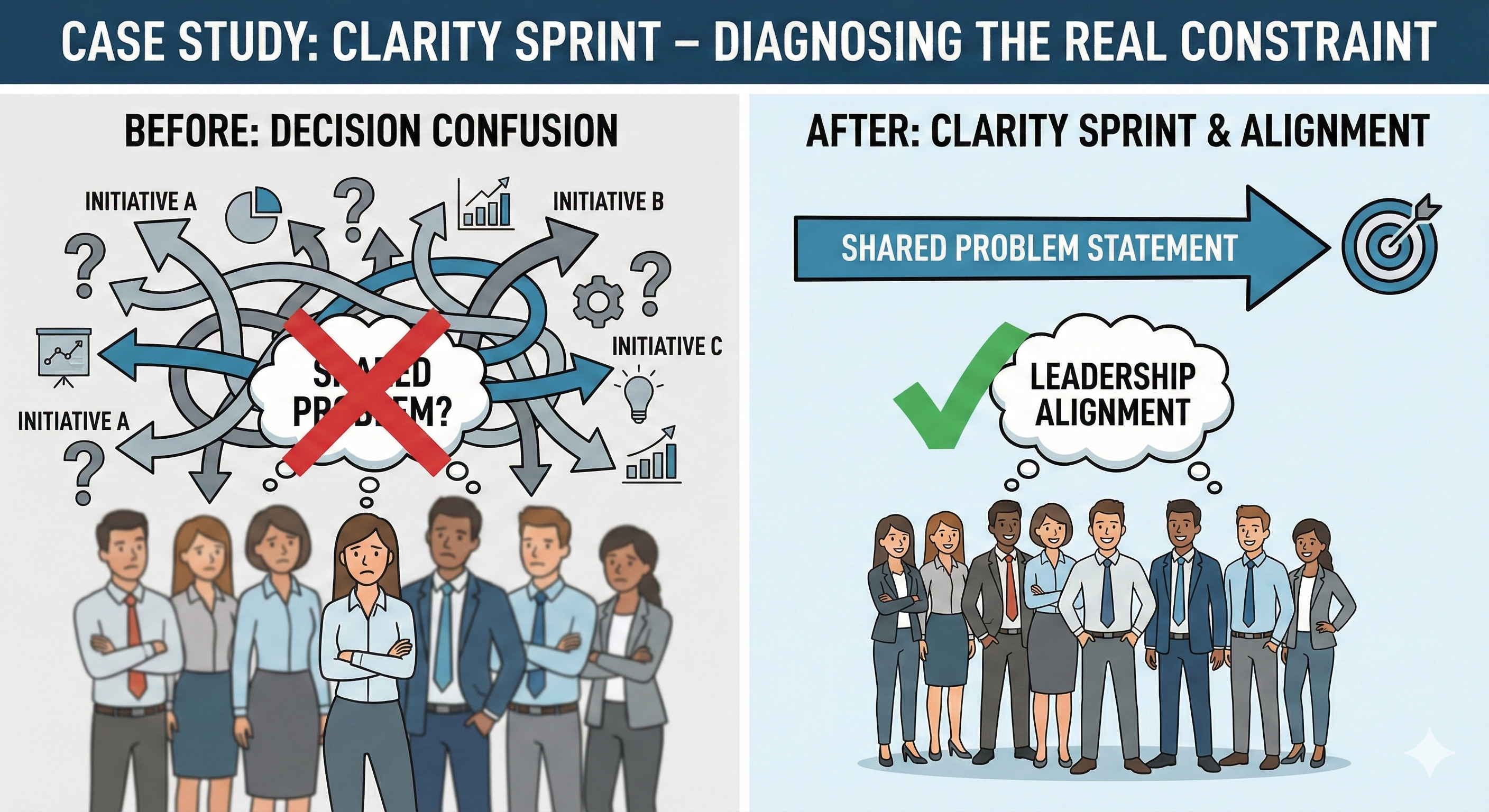
A sports organisation was considering multiple strategic and commercial initiatives simultaneously, including infrastructure upgrades, commercial partnerships, and leadership changes. Internal alignment was weak, and different stakeholders were operating with different assumptions about what decision was actually being made.
AGC was engaged to establish clarity before momentum drove premature commitments.
Symptoms
• Multiple initiatives progressing without a unifying decision
• Conflicting interpretations of priorities and urgency
• Pressure to “move forward” without agreement on objectives
• Early delivery conversations without a defined problem statement
Diagnosis
AGC conducted a Clarity Sprint to isolate the true decision requiring resolution.
The sprint examined:
• what decision was actually being made
• who owned that decision
• what constraints mattered (time, capital, governance, optics)
• which diagnostic would govern the real risk
The exercise revealed that the perceived urgency was masking a lack of decision clarity.
Prescription
AGC recommended a pause and reframe.
Rather than proceeding with fragmented initiatives, AGC set out a single governing decision and
identified the correct diagnostic pathway to test it.This prevented mis-scoped work and avoided unnecessary downstream cost.
Delivery (Where Warranted)
No delivery was initiated at this stage.
The Clarity Sprint functioned solely as a decision gate.
Outcome
• A single, clearly defined governing decision
• Explicit decision ownership
• Elimination of parallel, assumption-led initiatives
• Agreement on the correct next diagnostic step
Why This Matters
Misaligned decisions rarely fail immediately.
They fail expensively later.
The Clarity Sprint ensured the organisation did not move forward under false alignment.
Governing Diagnostic
Clarity Sprint
When to Use This Diagnostic
• When multiple initiatives are competing for attention
• When urgency exists without clarity
• Before selecting or scoping any other diagnostic