
Smart Venues, Smart Cities: The Future of Sports Infrastructure

Introduction: The Seamless Journey
Imagine it is match day. Your smart home device suggests the optimal time to leave based on real-time traffic data shared between your car and the city’s transport grid. As you approach the stadium, a notification reserves the nearest available parking spot. Your ticket is your face; you walk through the gate without breaking stride. Inside, an app guides you to your seat via the least congested route, offering a 15% discount at a food vendor with no queue. This is not science fiction; it is the near-future promise of a fully integrated smart venue operating in harmony with a smart city.
In our last article, we reimagined the stadium as a “flywheel”, a 365-day-a-year commercial and community hub. Now, we explore the engine that powers it: technology. This is the story of the data, connectivity, and intelligent systems that are turning our venues from isolated concrete islands into responsive, efficient, and deeply integrated nodes in the urban fabric.
The Problem: The Disconnected Experience
The traditional live event experience is notoriously fragmented and inefficient. Fans battle traffic, hunt for parking, wait in long queues for entry and concessions, and struggle with poor connectivity. The venue operates as a black box, with little real-time data on crowd flow, resource consumption, or fan behaviour. The city, in turn, treats the event as a traffic problem to be managed rather than a data-rich opportunity for civic optimisation.
This disconnect leads to:
- Operational Inefficiency: Overstaffing in some areas, understaffing in others. Energy and resources are wasted due to a lack of predictive analytics.
- Poor Fan Experience: Friction at every step, from travel to transaction, diminishes the magic of the live event and discourages attendance.
- Lost Revenue Opportunities: Without understanding fan movement and preferences, personalised offers and dynamic pricing are impossible.
- Civic Strain: Event days place a massive, uncoordinated burden on public transport, security, and sanitation services, creating friction with the surrounding community.
The Solution: The Sentient Venue
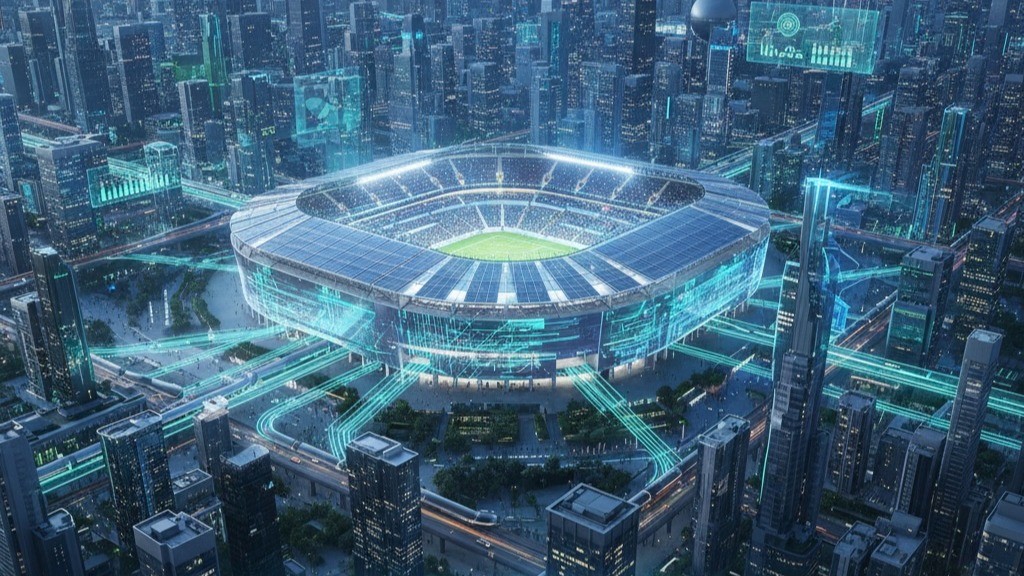
A smart venue is a sentient venue. It utilises a nervous system of IoT (Internet of Things) sensors, 5G connectivity, and AI-powered analytics to perceive, think, and respond in real-time. It does not just host events; it optimises them. When this venue is integrated into the broader smart city infrastructure, a truly seamless fan experience becomes possible.
The key technological pillars are:
- Digital Twin Technology: A living, virtual replica of the venue that allows operators to simulate crowd flow, test security protocols, and predict maintenance needs before they arise.
- IoT & Sensor Networks: Devices that monitor everything from temperature and energy use to queue lengths and waste bin levels, feeding real-time data to a central command centre.
- 5G & Ubiquitous Connectivity: The bandwidth backbone that enables everything from high-definition streaming for fans to reliable communications for security and operations staff.
- AI & Predictive Analytics: The brain that processes the data, predicting traffic patterns, suggesting optimal staffing levels, and powering personalised experiences for every single fan.
This creates a virtuous cycle: better data leads to a better experience, which encourages fans to engage more deeply, which in turn generates more data.
Real-World Applications: The Connected Ecosystem in Action
Look at SoFi Stadium in Los Angeles, which leveraged a digital twin during its construction to optimise design and is now using that model to manage operations with unparalleled efficiency. Or the Johan Cruyff ArenA in Amsterdam, a pioneer in smart energy management that uses its stadium batteries to help power the surrounding neighbourhood, turning the venue into a civic asset.
These venues are utilising technology to address real-world problems. Allegiant Stadium in Las Vegas uses analytics to manage crowd flow and direct fans to shorter concession lines, improving fan satisfaction and increasing per-capita spending. Across the world, facial recognition for ticketing is reducing entry times from minutes to seconds, eliminating a major point of friction.
The Smart Venue Playbook: A Framework for Integration
- Build the Digital Backbone First: A robust, secure, and scalable network infrastructure is non-negotiable. 5G and Wi-Fi 6 are the foundations upon which all other smart features are built.
- Prioritise Interoperability: The venue’s systems must “talk” to each other and to the city’s systems. Choose technology partners that embrace open architecture to prevent the creation of new data silos.
- Turn Data into Action: Collecting data is easy; using it is hard. Invest in an integrated command centre and an analytics team that can translate real-time data into immediate operational decisions.
- Create Public-Private Partnerships: True integration requires collaboration. Work with municipal transport, security, and utility departments to share data and co-create solutions that benefit the fan, the venue, and the city.
“A smart venue doesn’t just host a game; it has a real-time conversation with the city and every fan within it.”
The Venue as a Citizen
The next generation of sports infrastructure will be judged not just on its architecture, but on its intelligence. A smart venue is more efficient, more profitable, and offers a vastly superior fan experience. But more than that, when connected to the urban grid, it becomes a good citizen, a partner in creating a smarter, safer, and more responsive city.
The question for leaders is no longer whether to invest in technology, but how to build an integrated ecosystem where the venue, the fan, and the city all win together.