
The Powerhouse Pivot: Why 2026 is the Year Women’s Sport Stands Alone

Subtitle: The era of “proving the concept” is officially over. We are moving from a period of explosive momentum into an era of industrial-scale power, characterised by independent valuations, infrastructure growing pains, and the end of the “charity” narrative.
Introduction
For the past five years, the headline has been consistent: “Women’s sport is on the rise.” It has been a story of shattered attendance records, surprising viewership numbers, and a slow-dawning realisation that a massive, underserved market is waiting to be tapped.
Welcome to 2026. The rise is over. The powerhouse era has begun.
To continue calling women’s sport an “emerging trend” in 2026 is intellectual laziness. It is a fully established, high-growth global asset class that is now outperforming many legacy men’s properties in terms of engagement growth and ROI.
As we enter this new year, the conversation needs to shift drastically. We need to stop patting the industry on the back for growing and start analysing the intricate challenges of managing an industrial behemoth that is scaling faster than its infrastructure can handle.
The Shift: The Great “Unbundling”
The most significant shift defining 2026 is the “unbundling” of women’s sports assets.
For decades, women’s teams were treated as bundled dependencies, an add-on to a men’s season ticket package or a “throw-in” for a broadcast deal to sweeten the pot. That model is obsolete.
We are now seeing valuations based solely on the women’s properties’ standalone commercial merit. We are seeing media rights sold separately in highly competitive auctions. We are witnessing independent ownership groups, unconnected to men’s franchises, injecting nine-figure capital into leagues such as the NWSL, WNBA, and WSL.
This unbundling is crucial because it reveals actual market value. When you strip away the subsidies and the bundling, you do not find a charity case; you see a highly efficient asset class with a distinct demographic and superior growth margins.
Case Study: The Kansas City Current
To understand the power of unbundling and infrastructure control, we need to look at the Kansas City Current.
In 2024, they opened CPKC Stadium, the world’s first purpose-built stadium for a women’s professional team. Sceptics at the time called it a risky $117 million bet.
By January 2026, it is arguably one of the most successful pound-for-pound real estate assets in North American sports.
- Control of Schedule: Unlike teams that rent MLS or NFL stadiums and get “leftover” dates, the Current controls its calendar, maximising prime-time slots.
- Revenue Capture: They keep 100% of parking, concessions, and naming rights revenue that was previously shared or lost in tenant agreements.
- The Multiplier Effect: In its first two full seasons, the stadium did not just sell out; it tripled the club’s valuation and spurred a $800M+ mixed-use development in the surrounding riverfront district.
The Kansas City model proved that women’s teams are not just tenants; they are anchor tenants capable of driving massive regional economic impact.
The Bottleneck: The Infrastructure Crisis
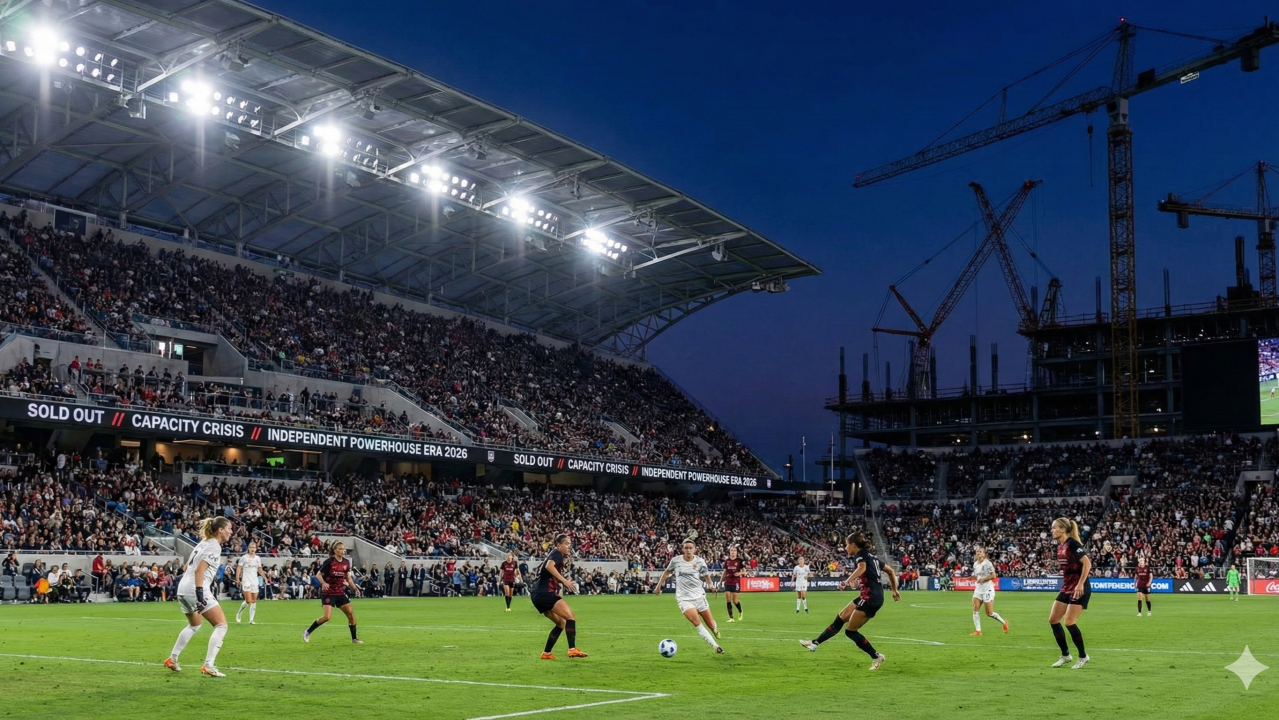
The success of projects like CPKC Stadium highlights the single biggest threat to the industry in 2026: The Capacity Crisis.
The demand curve has outpaced the supply of infrastructure. The charming stories of selling out small venues are no longer cute; they are evidence of lost revenue.
Women’s teams across the globe are consistently selling out facilities designed for “niche” audiences (2,000-5,000 seats), yet often struggle to secure consistent access to major stadia (20,000+ seats) due to scheduling conflicts with men’s teams.
The next frontier of investment is not just player salaries; it is bricks and mortar. We will see a wave of capital directed towards purpose-built venues or significant retrofitting of existing assets. The primary tenant is no longer always the men’s team.
Conclusion
The window for being an “early adopter” in women’s sport has closed. We are now in the mature growth phase.
The questions for leaders in 2026 are operational: How do we build infrastructure fast enough? How do we manage independent valuations? How do we scale globally without losing the unique community connection that fueled the initial rise?
The momentum is undeniable. Now, it’s about managing the power.