
The New Playbook: Why Fractional Leadership is the Game-Changer for Modern Sports Organisations

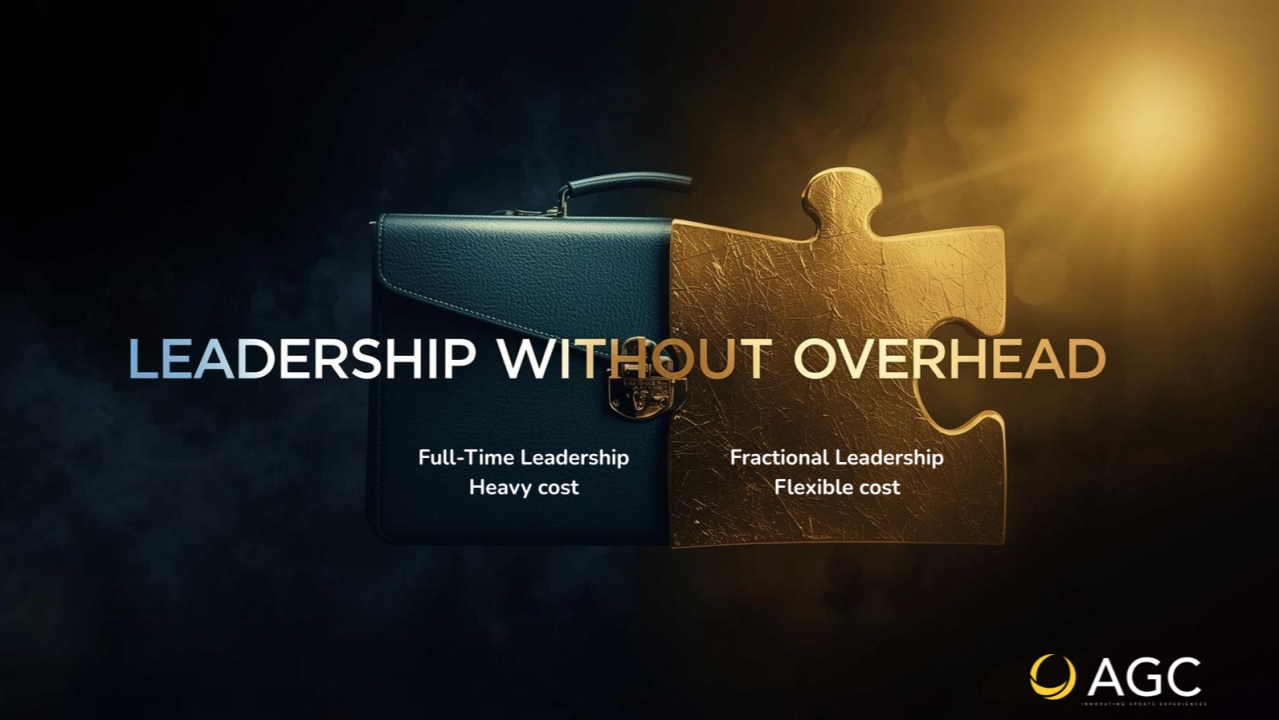
Leadership Without Overhead
Introduction: A New Era for Sports Leadership
Imagine you’re the president of a national football federation. Your dream is to launch a professional women’s league, host an international youth tournament, and digitise your fan engagement. Your ambition is clear, but your balance sheet tells a different story. The budget is stretched thin, and the immense cost of hiring a full-time CEO, a Commercial Director, and a Head of Operations makes your vision feel more like a fantasy.
This scenario is playing out in boardrooms across the global sports industry. Federations want to expand grassroots programs, clubs seek professional management to compete at a higher level, and event organisers chase world-class standards, all while navigating unprecedented financial pressure. The challenge is stark but straightforward: how can sports organisations access elite, game-changing leadership without the crippling overhead?
The answer lies in a strategic shift borrowed from the world’s most agile tech companies and private equity firms: fractional support. This model allows organisations to embed top-tier executives on a flexible, part-time basis, moving beyond the rigid, all-or-nothing approach to hiring. It’s not just about saving money; it’s about unlocking strategic agility, accessing a global talent pool, and driving measurable impact, precisely when and where it’s needed most.
The Problem: When the Traditional Leadership Model Breaks
For decades, the blueprint for sports leadership has been built around permanent, full-time executives, including CEOs, Technical Directors, and Marketing Heads. For major organisations with deep, consistent revenue streams, this model is viable. However, for the vast majority, national federations, emerging leagues, and non-profit sports bodies, it’s a structure fraught with challenges that stifle growth.
- Crushing Fixed Costs: The fully loaded cost of a C-suite executive (salary, benefits, bonuses) is often the single largest line item in an administrative budget. This financial burden limits investment in other critical areas, such as athlete development, coaching, and infrastructure.
- The “Swiss Army Knife” Fallacy: Smaller organisations often hire one senior leader and expect them to be an expert in everything, governance, finance, marketing, and operations. Inevitably, critical functions are neglected, not due to a lack of effort, but a lack of specialised expertise.
- Skill Mismatch and Stagnation: The leader who is perfect for a turnaround phase (stabilising finances, restructuring) may not be the right person for a high-growth phase (securing major sponsorships, international expansion). The permanent model makes it politically difficult and financially costly to adapt leadership to the organisation’s evolving needs.
- Risk and Instability: Losing a key full-time leader can create a massive vacuum, derailing strategic plans for months or even years. The lengthy and expensive recruitment process further compounds the problem, leaving the organisation in a state of limbo.
The result is a cycle of stagnation. Ambitious organisations overextend themselves financially, misallocate their most valuable resources, and ultimately fail to achieve their strategic goals.
The Solution: Full-Impact Leadership, Flexible Commitment
Fractional leadership offers a powerful new path forward. A fractional executive is not a hands-off consultant who delivers a report and leaves. They are a fully embedded member of your leadership team, accountable for results and integrated into your daily operations. They hold the title, authority, and responsibility of a senior leader, but for a “fraction” of their time (e.g., two days a week, ten days a month) and cost.
The benefits are transformative:
- Radical Cost-Effectiveness: Gain the strategic guidance of a seasoned COO or Commercial Director for a predictable monthly fee that is often less than half the cost of a full-time hire. This turns a major fixed cost into a flexible operational expense.
- Access to World-Class Talent: Suddenly, a mid-tier federation can attract a Commercial Director who has negotiated multi-million-dollar deals for a Premier League club. You are no longer limited to your local talent pool; you can now recruit the best talent from around the world.
- Unmatched Strategic Agility: Need an expert to guide you through a World Cup bidding process for 18 months? Or a marketing guru to professionalise your league for a single season? The fractional model enables you to deploy elite talent for specific projects and phases, ensuring that your leadership capabilities align with your immediate priorities.
- Knowledge Transfer and Upskilling: A great fractional leader doesn’t just perform tasks; they build systems and mentor your existing staff. They professionalise your operations from the inside out, leaving your organisation stronger and more capable than they found it.
Real-World Applications: The Fractional Model in Action
Let’s move from theory to practice. Consider a mid-tier cricket federation with a bold goal: qualify for the next ICC World Cup and build a sustainable commercial programme. Hiring a full-time CEO, Performance Director, and Commercial Head would be financially impossible.
Instead, they adopt a fractional approach:
- A Fractional CEO (10 days/month): Focuses on establishing robust governance frameworks with the board, managing stakeholder relationships with the ICC and government, and setting the long-term strategic vision.
- A Fractional High-Performance Director (15 days/month): Brought in for the crucial two-year qualification cycle to design player development pathways, implement performance analytics, and mentor national coaches.
- A Fractional Commercial Lead (8 days/month): Tasked with a single objective: to secure a title sponsor and two secondary partners, leveraging their global network to achieve what was previously out of reach.
The organisation gets three world-class leaders executing in parallel, for a combined cost that is still less than one permanent C-suite salary. This is how ambition gets translated into reality.
Or take a global event organiser planning a multi-sport games. Instead of carrying a massive permanent payroll for years, they use fractional experts to lead critical functions during the 24-month delivery cycle: a Fractional Head of Broadcast, a Fractional Head of Security, and a Fractional Head of Sustainability. Once the event is successfully delivered, their contracts conclude, leaving no lingering overhead.
The Fractional Playbook: A Framework for Success
Effective fractional leadership isn’t just about hiring a person; it’s about integrating a function. At AGC, our experience has shown that success rests on a holistic framework that blends strategy with execution:
- Governance & Strategy: The fractional leader must first work with the board to align on the constitution, clarify roles, and establish clear lines of accountability. Without a solid strategic foundation, execution falters.
- Operations & Delivery: They then embed themselves in the day-to-day, streamlining processes, managing risk, and building robust systems for everything from financial reporting to event delivery.
- Commercial Growth: With a stable base, the focus shifts to generating new revenue streams. This involves leveraging data to understand the market and building relationships to secure sponsorships, broadcast deals, and hosting rights.
- Innovation & Sustainability: Finally, forward-thinking fractional leaders integrate modern tools, such as data analytics, digital platforms, and sustainability practices, to ensure the organisation is not just successful today, but also resilient and relevant tomorrow.
Navigating the Challenges
The fractional model is not a magic bullet. Success requires careful management of potential pitfalls:
- Challenge: Cultural Integration. How do you embed someone who isn’t there 40 hours a week?
- Solution: A structured onboarding process is critical. Grant them a company email, add them to all leadership communication channels (such as Slack or Teams), and ensure they are present, in person or virtually, for key strategic meetings. Treat them as a leader, not a vendor.
- Challenge: Divided Attention. A fractional executive serves multiple clients.
- Solution: A clear Statement of Work (SOW) that defines priorities, deliverables, and communication expectations is essential. Great fractional leaders are masters of time management and compartmentalisation.
“Fractional doesn’t mean part-time commitment. It means full-value impact without full-time overhead.” – Adrian Griffith.
Leadership Without Limits
The sports world is at a crossroads, facing disruption from every angle, financial pressures, digital transformation, shifting fan behaviours, and rising expectations of good governance. Organisations that cling to outdated, rigid leadership models will struggle to keep pace.
Fractional leadership offers a bridge to the future, spanning ambition and affordability, vision and execution, and tradition and innovation. It is not a temporary trend. It is the new standard for how smart sports organisations can access world-class leadership, drive extraordinary outcomes, and build agile, resilient futures.
As you look at your organisation’s strategic goals for the next five years, the question is no longer “Can we afford the leadership we need?” but rather, “Can we afford not to lead differently?”